The purpose of this site is to inform and encourage constructive discourse – about society, politics, arts, and sciences. Please feel free to comment on (including critique) and share posts from this group and suggest new items to post.
Increase and multi-year-stabilize the Community Health Center Fund (CHCF) and Section 330 grants – Make it easier for new community-governed clinics (especially in “primary care deserts”) to become FQHCs or “look-alikes.”
Expand public / quasi-public insurance options that favor non-profits – Use standardized benefit designs and aggressive cost controls – Prefer or contract primarily with non-profit plans and safety-net providers.
Adjust Medicare and Medicaid payment rules so that (FQHCs, rural health clinics, public hospitals) receive enhanced, predictable reimbursement) with broadening of more complex care and strict assurance of quality and efficiency. And so that participation incentives in value-based models are stronger for non-profits — designed to reward healthcare providers for delivering quality care and achieving better patient outcomes while reducing costs – Quality Measures tracking – Cost Benchmarking – Pay-for-Performance – Accountable care Organizations – Patient Centered Medical Homes.
Targeted tax incentives for genuinely community-governed non-profits (e.g., FQHC-style boards, public representation).
State Governments:
Use Medicaid managed care procurement to favor non-profits – Explicitly bar or limit for-profit HMOs in Medicaid or other publicly funded markets – Score Medicaid MCO bids more favorably if the plan is Non-profit or public or Strongly contracted with FQHCs, public hospitals, and rural health clinics.
Design network rules that require safety-net / non-profit inclusion – For all state-regulated plans (Marketplace, small group, individual, sometimes large group), mandate that networks include: At least a threshold percentage of “essential community providers”—FQHCs, Ryan White clinics, safety-net hospitals, rural health clinics – Adequate participation from public hospitals and county clinics.
When new hospitals, outpatient centers, or beds are proposed, prefer non-profit or public applicants in CON decisions – Attach conditions to approvals that Require non-profit status.
Control hospital conversions and private-equity acquisitions – Restrict future sale to for-profit or private-equity owners – Require that distressed hospitals first be offered to public entities or community non-profits – Impose strong ongoing conditions on any for-profit acquisitions (minimum charity care, service lines, reinvestment requirements).
Create state public hospital authorities able to acquire failing private hospitals and convert them to public or non-profit status.
Local Governments:
Invest in and expand public hospital systems and their outpatient networks.
Use city/county capital budgets and bonds to – Build new primary-care and behavioral-health clinics – Acquire and reopen failing private hospitals as public/non-profit entities.
Use local public-health grant-making authority to: Fund community health centers, free clinics, and hospital-based outreach, requiring that funded partners be non-profit or public organizations.
Non-profit Organizations:
Scale up non-profit providers and innovative care models – Open new sites in areas saturated by high-price providers but underserved for low-income patients.
Lobby for CHC Fund reauthorization, Medicaid expansions, and public-option designs favorable to non-profit providers – Publish data on cost, access, and quality to argue for channeling more public dollars to the safety net.
Create or re-energize non-profit or mutual health plans (like the original BCBS model) that have broad networks including safety-net providers and reinvest surpluses in care infrastructure rather than shareholders.
Others:
Foundations – Endow non-profit clinics and hospitals, especially in distressed regions – Provide operating subsidies during transitions from for-profit to non-profit ownership.
Large purchasers (unions, public employers, universities) – Design benefit plans that prioritize non-profit/public networks and avoid high-price for-profit systems unless absolutely necessary – Negotiate value-based contracts with non-profit systems and direct employees toward FQHCs and public clinics for primary care.
Citizens, patient groups, and local organizations – Advocate for keeping hospitals and clinics non-profit or public during ownership changes – Support ballot initiatives or local ordinances that require public referenda before selling public hospitals – Strengthen requirements for community representation on hospital boards – Discourage private equity and venture capital acquisitions – Urge politicians to favor public or community-non-profit alternatives.
Ensuring establishment and maintenance of primary, secondary, and tertiary care within easily reachable distance for all persons in cities, suburbs, and rural areas. Public, NGO, and private sector coordination to ensure all persons can avail appropriately needed healthcare and medications though government facilities, government health insurance systems, self-pay, and/or private health insurance – dependent on the persons economic capabilities.
Supporting easy access and encouraging widescale use of medical practices support systems such as Artificial Intelligence chat-bots, AI-based clinical decision support applications, medical literature and knowledge repositories, and other appropriate mechanisms.
Ensuring that patient related information and clinical information from every patient encounter is captured in electronic medical records, which are then used for monitoring, training, and research.
Ensuring adequate wages for all types of medical personnel. Implementing periodic training and testing of all healthcare personnel for license maintenance. Requiring mandatory daily online check-in of all government medical personnel.
Implementing standardized testing in math, science, civics, and history for all students at selected grades (e.g., 6, 10, and 12) for all students for progression to next level.
Allocating a very relevant percent, such as 6%-9%, of the budget to education – education expenditures at national and local levels must ensure: maintenance of adequate and sufficient infrastructure including schools, classroom, seating, and books for all students across the country; adequate salaries for all teachers, including housing and transportation support where needed; availability of computers, laptops, and tablets in every school that are available to and used by all students (unless they have their own computers).
Provision of free school breakfasts and lunches for students from low income families through area-wise or school-wise means-tested programs.
Daily online reporting of all teachers from duty stations. Maintaining regularly updated local and/or national level data-base of all students and tracking of educational progress.
Mandatory refresher training and testing of all teachers every few years.
Expanded means-tested higher educational grants and loans availability for economically poor students.
Coordination between government, NGOs, and private sector to increase complementation and address gaps in availability of education and supporting services.
Development and broadcasting of short (e.g., 1-3 minute) and enjoyable programs (on TV, radio, and social media) – that are specifically focused on young students – on math, languages, science, and civics and society.
Strictly enforcing secularism in and removal of all religious practices from all educational institutions at all levels.
Sufficiently extensive micro-loan and small-loan programs, from non-profit, for-profit, and government sectors with prudent policies and oversight.
Facilitation by and support from government, non-profit sector, and academia – for development and dissemination knowledge transfer material – e.g., posters, quick-start guides, short-videos – that provide training and support to micro and small entrepreneurs to be successful in their endeavors. Such material should provide technical and vocational knowledge and skills, such as how to keep your chickens healthy. Such material should also provide entrepreneurial skills, such as – how to market your product effectively and efficiently, how to reach internal and international consumers by various means including the internet, what are enterprises may be most in demand; how to coordinate with other entrepreneurs and form groups and coops, how to expand, and how to link your micro or small enterprises to the production chain of larger enterprises, where that is applicable, increases efficiency, and creates win-win results.
Facilitation by and support from government, non-profit sector, for-profit sector, and academia – for the development of training and support for continually improving quality of products from micro and small industries – including the contexts of utility, durability, refinedness, and aesthetics (such as quilts and pottery having aesthetics that increase their demand internally and internationally).
Dedicatedly monitoring and supporting agricultural sector and rural area economic activities through improved infra-structure and logistics such as roads, transports, and cold-chain storage facilities, focused small agricultural grant and minimal interest loans, price support, widescale availability of broadband, expanding digital infrastructure and support such as mobile banking, consultation, and marketing, funding and policy support for agricultural research and innovation, development and dissemination of agri-tech solutions such as soil sensors, and expanding solar energy solutions.
Rigorously fostering the development of and broadscale adoption of small- and large-scale innovations and technological improvements. Strategies for this can include things such as small, medium, and large innovation grants and loans, mandated widescale technology adoption such as with regard to electronic health records and fintech, requirements for data compilation and sharing, and funding academic tech research and development. Any broadscale innovation adoption that can cause relevant decreases in labor demand should be paired with specifically targeted policies and program to mitigate/alleviate the deleterious impact.
Infrastructure development ensuring quick and easy connectivity between all points in the country by road and rail. Availability – electricity, natural gas, and gasoline – that is accessible all levels of entrepreneurs to sustain sufficiently positive returns.
Mitigation, oversight, and prevention of unfair business practices and removal of corruption in the government.
Continual rigorous and broadscale research on what policies, economic supports, and incentives are succeeding, which should be moved away from, and which new ones should be implemented. There should also be flexibility in central and local governing bodies, institutions, and policies to can make adjustments when sufficient evidence demands it.
Facilitating large scale foreign investment through the creation of the environment to attract foreign investment, such as establishing special economic zones, tax incentives, streamlined and simplified regulations, more educated and trained internal workforce, improved law enforcement and security, improved transportation and communication systems, robust digital infrastructure, reduced pollution and clean environment, and encouragement and strict protection of an inclusive and open-minded social environment. Also, large scale foreign investment should be paralleled with the host government’s uncompromisingly dedicated reinvestment of a substantial part of the additional public revenues that are generated into internal education, innovation support, and supporting medium and large entrepreneurial initiatives.
Mass scale rigorous math, science, civics, and sociology education through mandatory completion of 10th grade for every child, with access to good quality free public schools, and opportunities for completing a Bachelor’s degree at a minimal cost for anyone making a reasonable effort to do so. In addition, sufficient opportunities need to be available for students to complete Master’s degree or higher, regardless of their economic situation.
Backward linkage development of key industries that can be sustained through the internal market and/or external trade. Diversity in suppliers of raw and intermediate goods as well as consumer products.
Strengthening the fishing industry, where applicable, by supporting independent fishermen and small fishing enterprises through coordinated efforts of government, NGOs and non-profits, and private sector to provide housing, marketing, and logistics support, children’s education, healthcare, improved fishing and safety equipment, and training.
Large-scale hiring and investment in environmental clean-up and beautification programs at local levels with central support.
Aggressive and focused development of tourism sector through private and public partnerships ensuring environmental clean-up and maintenance, public security at all times, open and inclusive social norms that are protected by laws and law-enforcement, and modern and safe transportation.
Dedicated support from government, non-profit, and private sector for small and medium enterprises focusing on data science, AI, computer hardware systems, bio-medical computing, bioengineering, and laboratory science
Implementing mandatory, but confidential, annual reporting by government officials of all income and assets acquirement and their sources. The completeness and accuracy of reported information should be adequately verified for at least a small random selection of the reports.
Implement public complaint systems, operationalize, independent or semi-independent complaint review bodies, and ensure following of clear, fair, and standardized criteria, policies, and processes that identify and correct corrupt actions of government officials but also protect them against inappropriate accusations and incorrect or unfair corrective actions. Establish greater transparency regarding these processes and make summarized resultant information available to all.
Implement appropriate corrective measures – such as warnings, reprimands, suspensions, demotions, and firing for government officials violating policies.
Form and authorize a committee comprised of respected government, academia, and non-profit sectors that will bi-annually assess anti-corruption measures’ effectiveness and provide specific recommendations for any needed corrections.
Religions did not come to be and occupy its place in society and the social psyche because of a few and simply identifiable reasons. Rather, like many other things, it is a resultant of the interaction between a multitude of factors, from the past to present. A main force driving the formulation of religion, religious beliefs, and religious practices was of course the need for ways to cope with and persevere through dangers, calamities and losses; things a person had no control over. It was also a way to try to provide some explanation for phenomena that could not be explained at the time, to some things that are yet to be well explained, and something that can never be explained. Religion gives hope, even in the face of the direst adversity, that helps people to endure. Religion forms bonds and communities that people can depend upon and turn to during challenges small and large.
Since the early times of civilizations, many people who have held religious beliefs and engaged in religious or religion-based actions that were meant to have impacts beyond their own personal lives did so because of a deeply held purpose – such as to correct and prevent injustices, to protect and improve the well-being of their family and community, and to encourage, inspire, and even compel people to become better human beings.
Something that is probably also understood by most people is that much, though not all, of the factors that drive religious belief and practice as well as the conflicts between different groups that are based on religion are predicated on the distribution of and access to what is needed as well as desired – including adequate livelihood, wealth, resources, power, control over others -especially women, and luxuries. It is often underpinned by a conflict between those who have more and want to maintain or increase upon that and those who have less – and sometimes regardless of what had led to those differences. These contradictions have sown and will sow hate, jealousy, greed, ego, vengefulness, anger, and fear that will affect how people think, what group they choose to belong to, what group or beliefs they would like to encourage or compel others to subscribe to, and what they do.
All of these motivations and reactions associated with religion are results of the interaction of our evolutionary developed drives, the knowledge and information we have received, and the environment and circumstances each of us live in. Religions themselves were borne through these interactions and the resulting compromises, to help us cope with and persevere through uncertainties and adversities, to help tame conflicts within and between individuals and between groups, and to help structure and sustain communities within which people can live and function. However, where those lines of comprise were drawn, who benefitted more and who benefitted less, how religious doctrines and practices changed or evolved over the centuries, and how and for what purposes religion has been used or asserted have often been substantially determined by the power differences between individuals and between groups impacted by religion. Complicating this complexity even more is the fact that individuals and groups are not motivated by just a few factors; rather, consciously of instinctively, they are driven by a multitude of them, that are often conflicting with the same person or the same group. These are of course not particular insights. The fact is that there are so many interacting parameters, that it would probably be a challenge to be able to gauge and predict their effects, even at a macro level, by a deep neural network. But what is vitally important to consider is the fact is that in the rush of things we do that have religious motivation, we don’t pause to sufficiently to think about why we are doing what we are doing and how does it helps or hurts what our best selves want. More of awareness about the need for such reflection would probably be a good thing.
Religion, whether Islam, Hinduism, or any faith, can be a be a source of comfort, hope, inspiration, a calling for compassion and integrity, connection to a community with whom one can celebrate and on whom one can depend on, specially when facing uncertainties that are often around us. But when that is taken beyond the realm of personal practice of those benovalent characteristics of religion, and as soon as it starts to transgress upon the freedom of thought, speech, and practices of any other person, whether rudely or subtly, it transforms from something that can be beutiful to something that is detrimental to the well being and advancement of both the individual and society.
Creativity and innovation are fueled by freedom of thought and practice, as long they are constructive. When religion begins to limit that, including in how one can perceive and contemplate the world, that has a suppressive influence on all facets of the psyche, be it small or large. So even if you think the suppressive effect on creativity is miniscule, multiplied over countless thoughts of countless people, over many years will result in such people falling behind others that are unhindered.
I am not grounding my views about this on empirical evidence, though recent research seems to be indicating this (e.g., Krause V 2021; Dandorova-Robert Z 2023; Liu Z 2018; and El-Haq MMG 2016), but rather something that should be deducible through inferential reasoning. Such inferences should be predicated on the today’s social context, not that of a 1000 or 2000 years ago.
Similarly, religion, extended beyond personal inspirational context, hinders scientific progress. Religion demands unquestioning belief and conformity, whereas the the basis of science is questioning, experimentation, evidence generation, and reproducibility. Thus when religion begins to require, even demand, conformity to it from anyone, overtly or inexplicitly, it starts to narrow the path of science. Einstein had said “the important thing is not to stop questioning”. And it was Ibn Sina who said that knowledge can be acquired only through the study of its causes.
Sadly, the hindering extension of religion has been prevalent in several societies for ages and continues today, for the benefit of some. The extension of religion into the state, into law, and into education, and the overt as well as disguised propagation of religion to define, differentiate, and influence individuals and groups are saddening realities of such extension of religion (including Islam, Hinduism, and christianity) in many countries, to varying degrees. My hope is that will decrease and dissappear.
I do not think that of religion has been or is the only barrier to innovation and advancement, but it is one that could have probably been avoided, if sufficient number of capable people had tried to prevent that, instead of reacting to with complacency.
In my view, the beauty religion holds depends on what we understand it to be. For if in the name of religion, one subjugates women to men, trangresses on their freedom, and holds them unequal, or does these injustices to any one, then it’s no longer the light that it can be. In my view, the extension of religion beyond an inspiration for oneself to try to be a better person and care for others is when the light dims. The most negative forms of such extension expresses itself through the application of religious law and fundamentalism. And no matter in how sanitized and innocuous appearances such extensions may present itself as, the underlying repressive drives will always seek amplification.
In my view, and regrettably, the acceptability of the extension of religion to ordinary, often poor, people in many societies and in many circumstances was not necessarily because of thier the lack of knowledge and understanding but the lack of progressive, fair, non-corrupt individuals and institutions. Though ordinary people often do not have the opportunity to obtain education about science, sociology, civics, and philosophy (I hope they will have in the future, as this is one of the important things that can be beeneficial to them), I belive they, whether in villages, cities, or slums, still understand what affects them and how. However the lack of viable, fair, non-corrupt alternative institutions and activities that provide all (not just some) paths of economic and social sustenance and the realization of their hopes and dreams for themselves and their families have often left them no choice but to acquise to such extension of religion in the past. I think we must strive to create a clear path to away from those constraints.
My intent is not to philosophize for the sake of it. I know some find it fashionable to criticize the discussion of philosophy as being very academic. Philophical discourse may not be an answer for all illnesses but it can be a part of a process towards a solution. My intention is to express my thoughts and generate discussions among friends. Those two things should be doable. In addition, such discourse should be based on information and data, and an analytic mind to research for the answers.
How well such discourse is helpful, however will depend how we participate in it. For it be productive,
it should enable us to freely think about how achieve visible and perceiveable improvement in our social systems, institutions, and the human situation for all persons. It should enable us to be open minded on how we consider the circumstances affecting our efforts. It should enable us to focus on small day to day issues as well as larger conssiderations. Or it will be a fruitless investment in such efforts.
Philosophical discourse can be informative to what we strive for. I think thinkers such as Plato, Aristotle, Aquinas, Al-Thani, Rousseau, Hegel, Marx, Confucius, and Hamilton have all tried, from the vantage point of the stage of social development where they were standing, and drawing from the knowledge of their predecessors and contemporaries, to better understand the nature of humans, it needs, and it’s contradictions. And tried to find solutions to those contradictions, perhaps the harder task. Perhaps, the knowledge we have gained since can take us further in that regard. More than a 100 years ago, we know that such nature has an evolutionary and biological explanation, that have biochemical bases, which are predicated on physical principles. Though such considerations are intriguing, one doesn’t necessarily needs to delve in such depth; zooming out somewhat helps to see the trees and the forest. One can try to seek, understand, and find solutions to consider.
Search through the quagmire of good and bad information that surround us and finding and learning from those information pieces that truly help protect and advance the principles associated with social progress. The quagmire of information surrounding us include Facebook posts, YouTube videos, internet pages, Information generated by artificial intelligence, books and novels, stories and essays, news media provided information, institutional and government reports, movies, and many other elements.
Those who can, and to the extent they can – create, share, and/or reshare/reposte information products, such as Facebook posts, YouTube videos, internet pages, essays, reports, etc., that uphold and advance the principles associated with social progress. Such information products may be of news-worthy events, politics, economics, arts, culture, civics, society, philosophy, history, and many other things.
Support and help towards the enactment of progressive laws and their enforcement. For upholding and advancing the principles that bring societal progress, it is important that those principles and actions and activities associated with them are supported and protected not only by social norms and practices, but also by laws and law enforcement. In this regard, the legislations passed, the makeup of the courts, and enforcement of the laws are key factors that impact societal progress.
where it does not, as well as cannot easily be prevented from, hindering actions and activities that uphold and advance societal progress, including all the principles associated with that.
where it does not, as well as cannot easily be prevented from, freezing or decelerating social mobility and the individual’s opportunity for economic advancement.
where it does not, as well as cannot easily be prevented from, negatively impacting entrepreneurship, innovation, scientific and technological advancement, productive engagement, and productivity.
where it does not, as well as cannot easily be prevented from, negatively impacting, the ability to avail a fair share of the products of society by all members of society.
Different programs associated with wealth redistribution, such as progressive taxation and other mechanisms, are important and the appropriate forms of such programs depend on the particular circumstances. They must be fair and based on reason. In addition, its important to recognize that such programs will have limited and non-lasting effect unless they are supported by other sustained programs including delivery of education and training to those with limited access, the free availability of social and technical knowledge, access to transportation and other supports that enable productive engagement, easily accessible and transparent information about the entities comprising society and their activities and actions, infrastructure development, employment and production expansion, corruption alleviation, ensuring accountability of the government and social institutions, and ensuring societal process are directed by democratic processes and with assistance and guidance from progressive social institutions.
Principles that uphold and advance social progress are those that good men and women agree upon and include integrity | fairness | justice | truth | compassion and care | egalitarianism | basic human rights | social responsibility | individual freedom | the pursuit of happiness | ensuring the basic needs of and dignified living standards for all | ensuring opportunity for every person to achieve prosperity through reasonable effort | advancing and expanding innovation and productivity | freedom of religion | freedom to not believe in religion | freedom of press | establishment and maintenance of social institutions that can capably counter the government’s, businesses’, religious groups’, and anyone else’s attempts to hinder the principles societal progress | secularism | science | reason | decreasing ignorance and the lack of knowledge | maintaining an environment where everyone can freely and safely engage in constructive debate and discussion | and the reduction of social and economic disparities. Not a single one of these principles should be advanced in any way that impedes another one of the principles. That to some may seem like a challenge, but it is not a challenge that is realistically unsolvable.
Thus, in what we do as individuals, as groups, as part of organizations and institutions, and as part of government, we should always ask, does our actions and activities hinder any of these principles. If they do, then that needs to be corrected, elsewise stopped.
A question that naturally arises is how does someone know which information elements are true and which are false, what is real news and what is fake news, and, particularly, what upholds and advances social progress and what hinders it? In this regard, the question also arises as to how someone would know what actions and activities (that is activities of individuals, groups, organizations, institutions, or the government) uphold and advance social progress and what hinders it. The answer is not as hard as some would like people to think it is. Everyone already has knowledge that they have acquired, in school, from their family and friends, from their daily interactions with their community and environment, from the news and social media, and by various other means – they can use the knowledge they already have as well as acquire more information from the myriad of information sources and use their common sense to discern the validity of the information and whether that information, that action, or that activity protects and advances the principles that help to uphold and advance societal progress or do they hinder any of those principles.
It is a known fact that unbridled capitalism leads to concentration of wealth, resources, and power in the hands of a few, exploitation of workers and producers, disenfranchisement and disempowerment of the populace, stifling of competition, increase in poverty, and widespread social malaise. Thus, over the past century, regulated capitalism has tapped the drivers of productivity and innovation that are associated with capitalism – such as profit motive, self-fulfillment, and other evolutionary inherent human motivators – while mitigating and controlling the negative trajectories of capitalistic processes. And over the past century regulated capitalism has shown itself to be superior to other systems, particularly socialism, when considering the combination of productivity, innovation, social well-being, and societal advancement. To what extent the victory of regulated capitalism over socialism was achieved through fair practices and to what extent subversions and other unfair practices played a part may be a point of debate for some or many. But the fact remains that regulated capitalism has been shown to be superior, and pouting about that will benefit no-one.
Regulated capitalism, with all its faults, is still the best economic system that we have and very likely can have in the near future. This includes the numerous variants on regulated-capitalist systems across the world – such as the blend of free-market capitalism with government regulation and social programs in the U.S., social democracies with greater functions of the welfare states in Europe, and state-run capitalist economies of China and some other countries. But should we be satisfied with the current systems and be relatively passive towards the slow evolutions and changes among these variants of regulated capitalism with the assumption that superior variants will take hold and be adopted where best applicable? Or should we take a more active stance, try to identify an appropriate path forward, and, to the extent we can, nudge and push social transformations along that path. This is a very important question that all of us, with the help of experts, need to address.
An argument for a more active stance is implicated by the statement “regulated-capitalism, with all its faults, is still the best economic system”; these faults in our current systems have serious negative consequences and thus more robust efforts to transitions to less faulty systems (which may still be some form of regulated capitalism) seems to be logical. Perhaps regulated capitalism is like having a rhinoceros pull your cart instead of a horse where you are always needing to crack the whip on either side because the rhino can turn around and charge at you at any time – the rhinoceros and horse in this analogy represent human beings’ internal drives.
Consider also the facts that during the past 50 years we have seen the replacement of socialists economies by regulated-capitalisms, various transitions within regulated systems as to forms and extents of government and private sector involvement, substantial expansion of the non-profit sector, rapid technological advancements, substantially improved healthcare capabilities, and continued increase in production. During the same 50 years, there has also been a concentrating of wealth unto fewer people, widening disparities between the rich and the poor, widening disparities in income and in consumption capacities, several shocks to the markets, increased polarization of the population with substantial vitriol and violence, growing discontent with the economy and government among large sections of the population, outbreaks and continuations internationals conflicts and wars, a rise in racism, intolerance, and demagoguery, and a growing fear in the population about where the current trajectories in society are leading it to. Civil societies and governments are trying to grasp and address these concerns while needing to navigate through a shifting geopolitical landscape, a changed set of global rivals, continuing buildup of arms capable of mass annihilation, changes in impact potentials of various players, changes in social interactions and social dynamics brought on by technological advances, and new or changed impending threats. How all of these matters play out will, for better or for worse, and to some degree or a substantial degree, be impacted by the existent socio-economic systems.
In my view (the view of one ordinary citizen, who is concerned, and who tries to find out what experts and knowledgeable persons are saying about these things), the path forward should not be to drastically, or even substantially, replace regulated capitalism, market driven production, private ownership, and profit motive with alternative such as wide-scale transitions to public sector production, meticulous wage determination, or radical curtailment of wealth accumulation, whether or not such alternatives are potentiated by popular will and political power. The path forward should be enable alternatives to competitively update and, where indicated, replace current production and distribution processes – where and to the extent those alternatives prove to be, are seen to be, and are accepted to be better in terms of productivity, innovation, social well being of the populace, as well as social advancement – all being considered together. Thus, it is important to ensure a fair playing field where alternatives that are actually better are able to take root and thrive. It is important to encourage, support, and facilitate the search for, development, and controlled experimentation of alternatives and their monitored adoption and expansion if they do prove to be better. Along this path, more aggressive steps should of course be considered and implemented, when and where needed, to mitigate or redress rapidly evolving threats. However, in general, steps along this path can include:
Actively ensuring the robust presence and functioning of the government, the private sector, and the non-profit sector, as three parallel and coordinated modes for production and service delivery. As representatives of the entire populace, all traditional government functions such as societal governance, legislation and law enforcement, national security, should of course remain only in the realm of the government. The government’s robust role of maintaining a social safety net must also be preserved. However, services, social programs, as well as manufacturing, should have relevant involvement of all three sectors, to varying and changing degrees predicated on productivity, quality, innovativeness, efficiency, alignment with public needs, desires, and demands for the products and services, and the impacts on societal as well as employee wellbeing. Guided by these predicates, the changing and changeable infrastructure should encompass experimentation, piloting, adoption, and expansion.
Reviewing and reforming government organizational structures, policies, and procedures and making evidence-based changes to improve transparency, remove corruption and gaming of the system, ensure accountability, enhance staff performance, and establish management and direction by intellect and commitment to public good.
Facilitating the formation and empowerment of workers unions where there is adversarial situation between labor and management, where there is relevant disconnect between the means of production and the producers, where there is limited employees’ influence and control over work related policies, particularly related to wages, benefits, and work related processes, where employees are not integral and mobile participants in the span of decision making, management, and oversight, and where there is lack of standardized and broadly accepted policies and procedures that negate the need for unionization.
Developing, implementing, and expanding evidence-based policies and programs to support small entrepreneurship startups, partnerships, cooperatives, and establishing them as sustained components in the production chain, metered by productivity, quality, innovativeness, efficiency, impacts on societal well-being.
Robust policies and support from government and efforts from civil society to substantially expand the presence of the non-profit sector in service delivery and manufacturing. Such expansions should be monitored and tuned by productivity, quality, innovativeness, efficiency, and impacts on societal well-being. Government actions in this regard should include Targeted grants and loans, tax incentives, opportunities for public and non-public partnerships, procurement preferences, and regulatory streamlining. Civil society efforts can include such things as philanthropic and foundational investments, advocacy and awareness generation, the development of collaborative platforms for sharing data, knowledge, and know-how.
Government interventions and actions ensuring that the production potential generated by Artificial Intelligence are not controlled and monopolized by a few corporations. Government oversight and regulations in this regard will be needed to ensure that everyone can affordably and easily access the latest chat-boy models and APIs and large data resources (including appropriately reflective synthetic ones, where needed). Government oversight and regulations will also be needed to prevent the AI development and marketing resulting in increasing accumulation of economic, political, and social power by a few individuals, the stifling of competition, and the thwarting innovation arising from the populace.
Iteratively developed and robust steps to reduce the societal wealth gap through income taxes, estate taxes, and corporate taxes with dedicated and compulsory reinvestment of substantial parts of additional revenues, through grants, loans, trainings, research, subsidies, and other means, to increase overall productive enterprising. There should be continuous monitoring and tuning of these policies’ net effects on productivity and innovation.
Maintaining well administered means-tested programs for food, housing, transport, and childcare support tied with support, training, and requirements for productive engagement, wherever appropriate, and the transitioning off from support.
There needs to be concerted and continuous efforts to encourage, support, and sustain the actions and activities of individuals and groups to create, express, and/or disseminate works of arts and culture (including visual arts, performing arts, literary arts, media arts) that uphold and advance the principles associated with social progress.
Works of art and culture do not always need to have direct political or economic context or content, but they should not mis-represent or distort reality. A principal function of art and culture is to make life more enjoyable, even more worth living. And by such, it sublimely fuels the actions of activities that advance social progress, as long as the works of art and culture are not contradictory to principles that uphold progress. Works of art and culture not only can but should occupy places along the entire spans from the sublime to the ludicrous and from the focus of public enjoyment to inspiration to calls-to-action.
Efforts to encourage, support, and sustain the art and culture that uphold and advance social progress include monitory and in-kind assistance from individuals, organizations, foundations, and the government, legal protections and the enforcement of such protections, support and protective assistance from social institutions including the press, and the engagement and interaction between the public and those involved in producing and/or disseminating the art the works of culture.
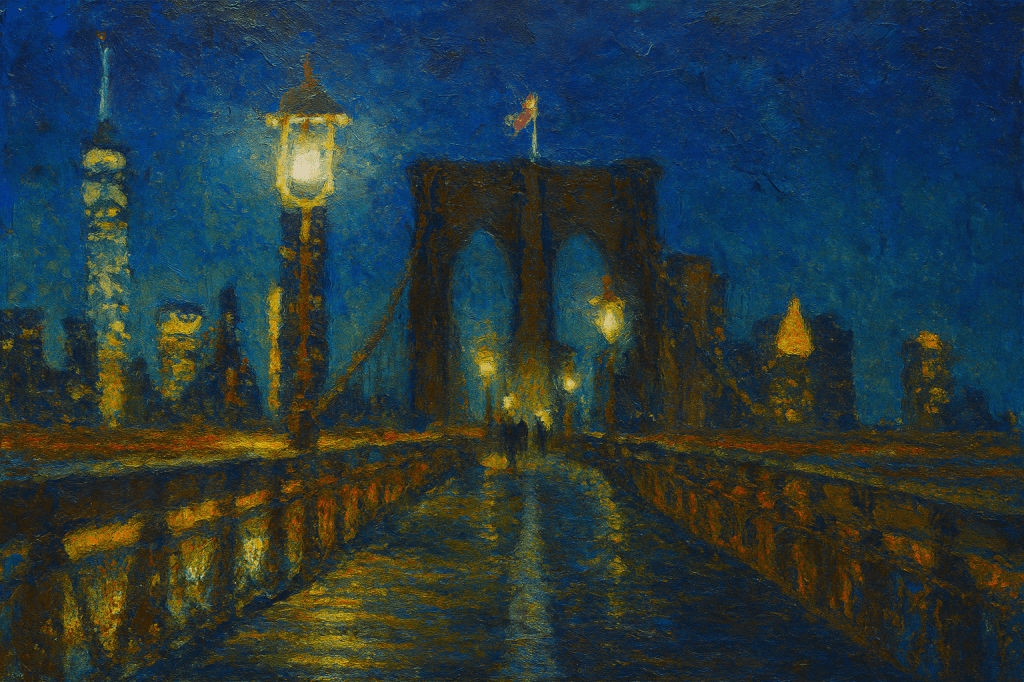
Perhaps some bridges are held up as much by cables as by whispers
Note: This is a work of fiction. Names, characters, institutions, and incidents are either products of the author’s imagination or used fictitiously.
The RAV4 sped down the Brooklyn–Queens Expressway, the BQE as commonly known, cutting through quiet stretches of Queens after midnight. Emilio Ortiz, a slim tall man, held the wheel with one hand, alternating between right and left as he often did. He loved driving at this hour—one of the few windows in New York City when the expressways actually allowed going from one place to another without running into a jam. To Emilio, the hum of the engine and the speed of the motion was enticing.
There were still several cars on the BQE, it was New York, after all. They were heading south toward the Brooklyn Bridge, though Emilio’s favorite stretch lay just beyond the Brooklyn Bridge exit, where the curved elevated lanes hug the East River. From there, Manhattan unfurls on the right.
A red Corvette flashed by on the left, cutting sharply into his lane. Emilio tapped the brake, letting it dart ahead. Behind it, a yellow Mustang swerved past in pursuit, engines roaring—an impromptu midnight race across the BQE.
Dr. Edward Langley, sitting in the passenger seat, flinched slightly, pressing his palm against the dashboard. Emilio glanced at him—Langley looked relaxed, almost amused. Free racing on New York highways was not unusual, and Langley’s calm somehow reflected that.
He thought again of the dinner earlier that evening—the three of them, Langley, Purabi, and himself.
___________________________________________
Emilio had called around 7:30 p.m., and Langley hadn’t sounded surprised. In fact, he seemed quietly pleased. Dinner was set after nine; Langley and Purabi’s dinners always were. Emilio arrived a few minutes past nine with a bottle of sweet red wine.
It has been years since Emilio had seen Langley and Purabi, but their Corona, Queens apartment hadn’t changed much—same layout, early-twentieth-century furniture. The carpet was new, a light brown that softened the shine of the oak floor. A strong current of cumin and pepper drifted through the living room.
As they exchanged pleasantries—it’s been so long, how have you been—Purabi Haque appeared from the kitchen, wearing a rumpled blue cotton saree. Her hair was slightly disheveled, her face glistening with perspiration, from the heat of the stove. “Oh, Emilio, you came, good, sit dear,” she said, smiling before disappearing back into the kitchen.
She looked heavier than the last time he saw her, but still attractive. Emilio had always found her so, not just because of her features but also in how she carried herself. Emilio felt a strange relief at seeing her. He hadn’t known if she would be there and hadn’t asked when he called Langley. Something picked at Emilio inside, would he have been also glad if she wasn’t here tonight?
Dinner was a simple arrangement of rice, vegetable fry, beef curry, and lentils. Langley always loved Indian food, more even than Purabi did. The sweet red Emilio had brought seemed welcomed. They talked about the years gone by—their work, Langley and Purabi’s children, old friends.
Ed and Purabi’s son, Atiq, was teaching physics at an four year college now. Their daughter, Rana, was finishing law school and had been active in the recent pro-Palestinian marches in Manhattan.
Politics floated with the aroma of cumin—Gaza, Donald Trump, tariffs, taxes—the conversation drifting between memory and the present. Emilio didn’t feel like going home. Langley may have sensed this. He had suggested going for a walk—one that led to the Brooklyn Bridge.
Purabi had stayed back, saying she had something to finish.
___________________________________________
Something had been nudging Emilio—from the moment Rachel had mentioned Langley’s name that afternoon at the coffee shop. He wanted to know where Langley’s thoughts, once so confidently conveyed, lay now. Like wanting to know if the storyline of a sequel of a favorite movie was what you were thinking, what you were hoping for. Their conversation during had touched slightly on that.
As the RAV4 rolled down toward the Cadman Plaza exit, Emilio said, with his gaze still on the road,
“You know, I still think about why socialism in the Soviet Union and China failed? Was it because they just could not establish an alternative social consciousness that could rival profit motive… because of dogmatism, opportunism, corruption… subversion from within and from outside… divestment the populace from democratic engagement and expression of dissent…doctrinally defining art…negation of institutions that guard society and its individuals…or not understanding the place religion holds in hearts and minds or the need to reward effort and excellence?”
Emilio paused for a second. He knew that he often hammered his argument, he had learned this from Langley.
“Or perhaps it was the naive neglect of the evolutionary acquired instincts and drives that got our species here in the first place?” Finally finishing.
Langley listened, with his gaze kept on the highway. When he finally replied, his voice was low and even:
“Did they fail? Or did they play out the transitory transformational roles they were supposed to, given the developments reached at the time?”
It wasn’t the answer Emilio expected.
He slowed, scanning both sides of Washington Street for parking. The underpass below the Bridge was half-lit, a patchwork of sodium lamps and shadow. Langley pointed. “There—between the Sonata and the Jeep.”
“It’s kind of tight,” Emilio said. “I’ll guide you in. Stop.”
Langley got out, motioning him back and forth until the blue RAV4 was parked. It was past one in the morning, but the area wasn’t empty. A couple holding hands walked by, they seemed perhaps in their early thirties; the man was wearing jeans and a grey shirt, and the woman was wearing a light blue dress. He was saying something to her, and she was smiling. They disappeared into the enclosed stairway, within one of the bridge’s foundations, that leads to the bridge’s pedestrian walkway above.
A halal food truck was spewing steam near the entrance of stairway. A group of three young women, probably in their early 20s, were standing in front of it talking to the vendor and to each other. They were buying sodas and chips. They were loud and cheerful.
The vendor’s appearance and accent were south Asian, maybe Pakistani or Indian, or Bangladeshi—Emilio couldn’t say; Purabi probably would have been able to he thought.
He longed to feel her palm again—pressing against his cheek—years ago, in that living room, on a late winter night. It was snowing. The soft yellow light from the table lamps in the room made the white snowflakes more visible through the window, falling gently. She was standing in front of him.
“We never…” he had said softly, not finishing what he started to say. “I know, dear,” she had replied.
___________________________________________
They bought two bottles of Diet Coke and climbed the enclosed stairs. The bridge opened before them under a clear night sky—a wide wood-planked walkway gleaming under the floodlights housed in gaslight stands of a century ago, the suspension cables with garlanded lights spread along their lengths rising against the deep blue night. The East River shimmered below.
They were walking toward the Manhattan side of the bridge. It was spring night with a moderate breeze. By the time they reached the middle, Langley stopped, sipped his Coke, and looked toward the Manhattan skyline— countless skyscrapers stretching for miles from One World Trade Center downtown to the Empire State Building in midtown and beyond, all glittering with their lights and beams against the dark.
“What we have built together, right?” he said. Emilio smiled. “What, a shining city?”
“Well, perhaps something along that way—with its many flaws and faults still to be corrected,” Langley replied.
They walked over to the left side of the walkway and leaned with their forearms on the thick rivetted steel guardrail, bottles resting beside them. Ahead on the bridge, the three young women sat on the guardrail, talking and laughing—one with a keffiyeh, another in an ‘Elect Mamdani’ t-shirt, the third wearing a faded Beatles print.
“What do you think of Mamdani?” Emilio asked. “I think he has some popular ideas, like making New York City buses free.”
Langley took his time, as always.
“It’s an interesting idea; probably will increase demand for bus services, which could push for efficiency. Did he say how they’ll pay for it? Within a progressive tax system, probably it works. I think one good thing he’s done—and Bernie, for that matter—is de-vilifying the word socialism. Perhaps they’ll redefine it, set its contours, where it applies, where it doesn’t, and where and how it can fit into and enhance the positive trajectories in our current context.”
The two men stood in silence for a while, looking eastward toward the faint glow of the Atlantic horizon. Then Langley spoke again, softly, almost as if to himself:
“There needs to be a multitude of activities and actions that complement each other… continually and relentlessly…toward the goal of what we want our community, our society, our world to be. Actions of individuals, small and large groups of people engaging with each other informally, civil society organizations, non-profit institutions, and in fact, for-profit institutions too if they care about the world they will live in, academia, and governments and their instruments. Such actions may not connect directly, but they’re tied by that goal, as we see it from where we stand today, and by an understanding of how such action takes us towards that goal, even if in a very small way.”
Emilio listened but to him it sounded simple and neat. He’d once admired Langley for his depth, but maybe the years had rolled faster than him.
Emilio was wanting more from his well-regarded friend, the aging professor of Political Science. He first met Langley when he enrolled in Langley’s class during his sophomore year at the university. One of his friends had suggested the course to him – Dr. Langley is easygoing and the discussions in the class are engaging, students really get into it.
___________________________________________
Emilio was having coffee with Rachel on the upper east side earlier today, before he called Langley, out of the blue. Rachel and he had become good friends since they first met at a Movies Meetup group.
Emilio started going to the meetup to find something fun to do, to just hang out, unencumbered from organizational ties and responsibilities. Rachel was also a PolSci grad. The conversation traced one thing to another and led to talking about Langley’s class. Emilio had felt like going to see Langley and Purabi many times in these past years, but he didn’t. He wasn’t sure wat he longed for, the long late-night debates, the presence of Purabi, or something more.
Emilio remembered gatherings and banter at Langley and Purabi’s apartment. They owned the 9th floor apartment with an unabated view of the Manhattan skyline from the living room. It was a Coop, like many of the multi-unit residential buildings in New York. Many of these were built in the 1950’s and 60’s; brick faced buildings with one-, two-, or three-bedroom units. The kitchens were usually a tad small.
More than one person there would make it feel like a cramped space. Emilio remembered such instances when he or some other student would be helping set the dining table as Purabi was finishing up the cooking. Langley was somewhere in the living room doing something, perhaps selecting a disc to play on the CD player—a Peter, Paul and Mary—Emiolio could hear in low volume, “Where have all the flowers gone, long time passing. Where have all the flowers gone, long time ago…”.
Every few weeks or so, some of the PolSci graduate students would gather for dinner at the apartment, sometimes at Langley’s invitation and sometimes through self-invitations. Some of the undergrads would tag along with the grads, and Emilio was one of them. Loud conversations before, during, and after dinner: Clinton, Iraq, 9/11, the collapse of the Soviet bloc, Palestine. Langley spoke only sparingly, but
the room quieted when he did. Purabi often sat nearby, sometimes joining in, sometimes watching quietly. She held a Master’s in English Literature and her grasp of the classics was impressive. But her understanding of politics was not minimal.
Most of the gatherers at these dinners were liberal, like Langley, Democratic Party supporters, some already active as organizers. There were one or two, including Emilio, who were members of a Socialist organization. In a country dominated by Democrats and Republicans, these gatherings felt like a reprieve to him—he, who was one of the torchbearers for a better day.
Later on, Emilio would often visit Langley and Purabi just by himself; arriving after dinner time with a bottle of wine or some fruits from sidewalk vendor. They would talk late into the night as a few empty Heineken bottles and a near empty bottle of Merlot or Reisling accumulated on the coffee table. Langley did more talking during these sessions, Emilio did more questioning, wanting to engage Langley in debate, to test and sharpen his own arguments. The kids were in their beds, but Purabi would usually be near, interjecting her thoughts now and then, and sometimes digressing to some other topic.
“Have you seen the movie Chariots of Fire”, Emilio could remember her saying, on some distant night.
Emilio’s attention returned to the bridge with the sound of slow footsteps. The young couple they had seen when parking their car, was walking back towards the Brooklyn side. The man had wrapped his arm around her waist, and she was leaning her head against his shoulder. Her dress was fluttering in the breeze, which had increased. It felt a little gusty. It was cool.
For an instant, Emilio’s eyes met hers as they passed.
“In the flicker of light, during the blink of the eyes, when I do see you”, he thought – remembering some lines translated from an old song by Rabindranath Tagore that Purabi liked to listen to.
___________________________________________
Emilio thought about what Langley had just said about a multitude of complementary activities and actions. Langley was still peering out toward the Atlantic.
“There are many such constructive activities in the world…and have been for centuries. Are you saying we just need more of that?” Emilio finally asked.
Langley replied in his calm manner—”Well yes, there has been countless constructive efforts, and that has gotten us this far, without ending up with wide-spread dystopia, though many may argue that what we are hurtling towards nowadays…But have you accounted for the reality of today…where there is more, wider, and faster availability of information, through news media, internet, social media, and artificial intelligence…more interaction and engagement between people, though mostly digitally, from sharing pictures with your friend circle of what you are eating to organizing protests…I agree that the decrease in in-person interactions, where that has occurred, has been a negative consequence, and that has to be addressed…however, because of many factors, many more people than before are more empowered today to make a difference, in some way or form.”
Langley had paused, but Emilio didn’t say anything, trying to process what Langley was saying.
Langley continued, “and perhaps, there is an increasing feeling that all is not well, that where we are headed is not where we want to go to.”
Emilio was still silent. He knew Langley had more to say.
Langley was looking down at the expressway, just a little below the walkway, on which cars were zooming by—there was an expressway on either side of the walkway, in opposite directions.
More seconds passed before Langley spoke—“progressive actions of individuals, groups, and organizations occur in environment of a myriad of competing and conflicting interests, both between individuals, groups, and nations, as well as within individuals, groups, and nations…But within this quagmire, the various actions, of various groups, in various places, piece by piece, and parallelly, can be driven by that goal…a well-defined and desired set of economic, social, political, and cultural norms…I think that can be sustained, though requiring constant struggle to do so, expanded where it lags, and perhaps further enhanced.”
Emilio turned his head and asked softly. “So, no Nash equilibrium?” Langley didn’t look at him.
“The equilibrium point can be shifted, as you know,” he said.
___________________________________________
“You will come again tomorrow night, won’t you?” Emilio heard again Purabi’s whisper, standing on the bridge, many years and many miles removed from that late night in that apartment.
Emilio was standing in front of the living room window, hands in his pant pockets, staring out at distant lights of the Manhattan skyline. Purabi was sitting on the beige carpet with her back against the seat of the sofa. She was wearing a long dress she would often go and change into at some point during these late night chats…sometimes staying a while longer before going off to bed, sometimes staying the whole while. She was sitting there looking at the carpet in front of her as she spoke…Langley was sitting on the carpet with his back leaning against the reclining chair that faced the sofa. He was pouring some Jurancon into a silver rimmed three-inch glass – he was fond of sweet wine, but mainly, he was a gin and tonic person… Langley had just finished talking about Reagan’s visit to the Soviet Union and O’Neal’s phone call to Brezhnev requesting a warm welcome.”
Emilio was sitting near Langley as he was speaking—then got up and walked to the window.
“But we know there were more forces at play affecting those talks.” Emilio said, “But it’s now 3:30 in the morning, and I have to get going.” This is when Purabi had asked if he would come tomorrow. Emilio did not respond as he slowly turned and walked towards the door. He knew they would be here again tomorrow.
___________________________________________
Now, on the bridge, they were walking again towards where the bridge starts on the Manhattan side. The skyline was nearer.
Emilio felt a harrowing inside of him. Something he felt now and then.
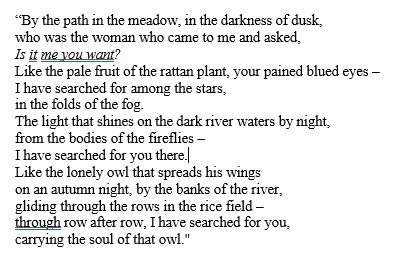
He remembered a few lines of a Bengali poet named Jibonananda Das that Purabi had once translated, sitting on the carpet in that apartment, on some late night, long ago.
The lights of Manhattan glimmered on the East River–the wind pressing on him. Emilio stood silently with his gaze there, as the whispers of a woman’s voice threaded through the years.
As we all know, present day society is comprised of multitudes of various entities, including individuals, families, groups, organizations, institutions, academia, micro enterprises, small businesses, large corporations, non-profit establishments, artists, bureaucrats, government agencies, governments and nations, as well as many other types of bodies. Each of these entities engage in activities and carry out actions that are influenced by its situational context and its goals and objectives. Such actions and activities span the range from passive and indiscernible to the distinct, focused, and forceful. This myriad of actions and activities directly or indirectly influence, impact, and connect the entities engaged in them. This myriad of actions and activities include those that uphold and advance the principles of societal progress and those actions and activities that hinder those principles. The conscious, continual, and relentless efforts of the entities in society that do believe in advancing societal progress to understand and identify which actions and activities are consistent with the principles of societal progress, the continual and relentless efforts of such entities to support, sublimely or overtly, and to the extent its possible for each, to inform about and to engage in actions and activities that uphold and advance the principles of societal progress, is what can define the dominant trajectory in society. Such conscious, continual, and relentless efforts, despite challenges and setbacks, can transition society to more progressed states. Also, that purpose, mission, and struggle itself then becomes a motivator that can rival multitudes of other human drives.
 Bridges Between Us