A Short Story by: Anonymous
Perhaps some bridges are held up as much by cables as by whispers
Note: This is a work of fiction. Names, characters, institutions, and incidents are either products of the author’s imagination or used fictitiously.
The RAV4 sped down the Brooklyn–Queens Expressway, the BQE as commonly known, cutting through quiet stretches of Queens after midnight. Emilio Ortiz, a slim tall man, held the wheel with one hand, alternating between right and left as he often did. He loved driving at this hour—one of the few windows in New York City when the expressways actually allowed going from one place to another without running into a jam. To Emilio, the hum of the engine and the speed of the motion was enticing.
There were still several cars on the BQE, it was New York, after all. They were heading south toward the Brooklyn Bridge, though Emilio’s favorite stretch lay just beyond the Brooklyn Bridge exit, where the curved elevated lanes hug the East River. From there, Manhattan unfurls on the right.
A red Corvette flashed by on the left, cutting sharply into his lane. Emilio tapped the brake, letting it dart ahead. Behind it, a yellow Mustang swerved past in pursuit, engines roaring—an impromptu midnight race across the BQE.
Dr. Edward Langley, sitting in the passenger seat, flinched slightly, pressing his palm against the dashboard. Emilio glanced at him—Langley looked relaxed, almost amused. Free racing on New York highways was not unusual, and Langley’s calm somehow reflected that.
He thought again of the dinner earlier that evening—the three of them, Langley, Purabi, and himself.
___________________________________________
Emilio had called around 7:30 p.m., and Langley hadn’t sounded surprised. In fact, he seemed quietly pleased. Dinner was set after nine; Langley and Purabi’s dinners always were. Emilio arrived a few minutes past nine with a bottle of sweet red wine.
It has been years since Emilio had seen Langley and Purabi, but their Corona, Queens apartment hadn’t changed much—same layout, early-twentieth-century furniture. The carpet was new, a light brown that softened the shine of the oak floor. A strong current of cumin and pepper drifted through the living room.
As they exchanged pleasantries—it’s been so long, how have you been—Purabi Haque appeared from the kitchen, wearing a rumpled blue cotton saree. Her hair was slightly disheveled, her face glistening with perspiration, from the heat of the stove. “Oh, Emilio, you came, good, sit dear,” she said, smiling before disappearing back into the kitchen.
She looked heavier than the last time he saw her, but still attractive. Emilio had always found her so, not just because of her features but also in how she carried herself. Emilio felt a strange relief at seeing her. He hadn’t known if she would be there and hadn’t asked when he called Langley. Something picked at Emilio inside, would he have been also glad if she wasn’t here tonight?
Dinner was a simple arrangement of rice, vegetable fry, beef curry, and lentils. Langley always loved Indian food, more even than Purabi did. The sweet red Emilio had brought seemed welcomed. They talked about the years gone by—their work, Langley and Purabi’s children, old friends.
Ed and Purabi’s son, Atiq, was teaching physics at an four year college now. Their daughter, Rana, was finishing law school and had been active in the recent pro-Palestinian marches in Manhattan.
Politics floated with the aroma of cumin—Gaza, Donald Trump, tariffs, taxes—the conversation drifting between memory and the present. Emilio didn’t feel like going home. Langley may have sensed this. He had suggested going for a walk—one that led to the Brooklyn Bridge.
Purabi had stayed back, saying she had something to finish.
___________________________________________
Something had been nudging Emilio—from the moment Rachel had mentioned Langley’s name that afternoon at the coffee shop. He wanted to know where Langley’s thoughts, once so confidently conveyed, lay now. Like wanting to know if the storyline of a sequel of a favorite movie was what you were thinking, what you were hoping for. Their conversation during had touched slightly on that.
As the RAV4 rolled down toward the Cadman Plaza exit, Emilio said, with his gaze still on the road,
“You know, I still think about why socialism in the Soviet Union and China failed? Was it because they just could not establish an alternative social consciousness that could rival profit motive… because of dogmatism, opportunism, corruption… subversion from within and from outside… divestment the populace from democratic engagement and expression of dissent…doctrinally defining art…negation of institutions that guard society and its individuals…or not understanding the place religion holds in hearts and minds or the need to reward effort and excellence?”
Emilio paused for a second. He knew that he often hammered his argument, he had learned this from Langley.
“Or perhaps it was the naive neglect of the evolutionary acquired instincts and drives that got our species here in the first place?” Finally finishing.
Langley listened, with his gaze kept on the highway. When he finally replied, his voice was low and even:
“Did they fail? Or did they play out the transitory transformational roles they were supposed to, given the developments reached at the time?”
It wasn’t the answer Emilio expected.
He slowed, scanning both sides of Washington Street for parking. The underpass below the Bridge was half-lit, a patchwork of sodium lamps and shadow. Langley pointed. “There—between the Sonata and the Jeep.”
“It’s kind of tight,” Emilio said. “I’ll guide you in. Stop.”
Langley got out, motioning him back and forth until the blue RAV4 was parked. It was past one in the morning, but the area wasn’t empty. A couple holding hands walked by, they seemed perhaps in their early thirties; the man was wearing jeans and a grey shirt, and the woman was wearing a light blue dress. He was saying something to her, and she was smiling. They disappeared into the enclosed stairway, within one of the bridge’s foundations, that leads to the bridge’s pedestrian walkway above.
A halal food truck was spewing steam near the entrance of stairway. A group of three young women, probably in their early 20s, were standing in front of it talking to the vendor and to each other. They were buying sodas and chips. They were loud and cheerful.
The vendor’s appearance and accent were south Asian, maybe Pakistani or Indian, or Bangladeshi—Emilio couldn’t say; Purabi probably would have been able to he thought.
He longed to feel her palm again—pressing against his cheek—years ago, in that living room, on a late winter night. It was snowing. The soft yellow light from the table lamps in the room made the white snowflakes more visible through the window, falling gently. She was standing in front of him.
“We never…” he had said softly, not finishing what he started to say. “I know, dear,” she had replied.
___________________________________________
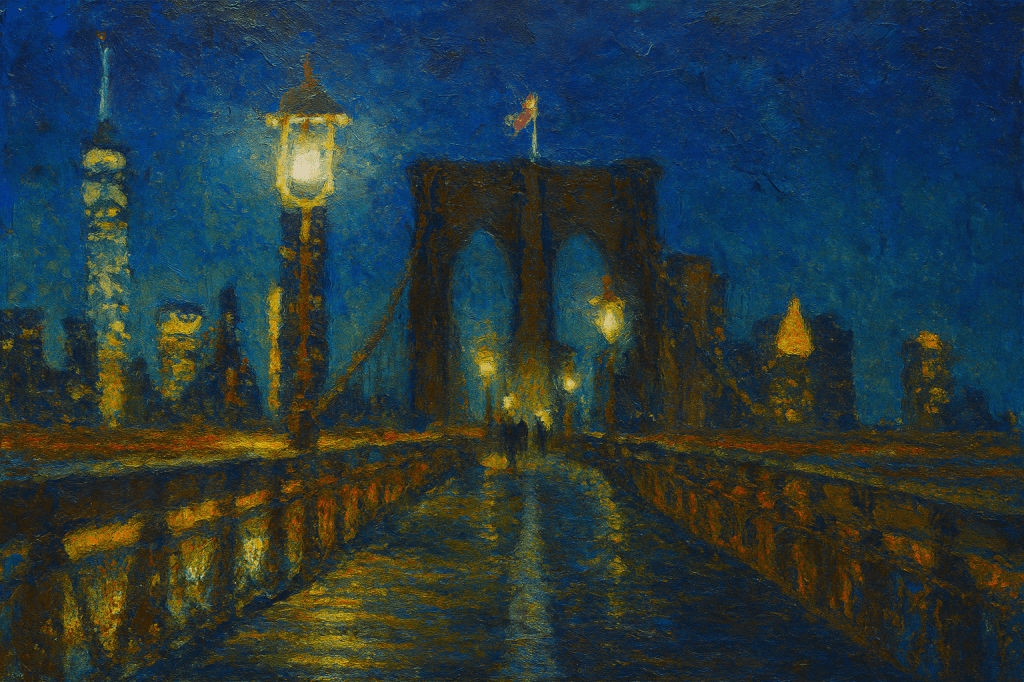
They bought two bottles of Diet Coke and climbed the enclosed stairs. The bridge opened before them under a clear night sky—a wide wood-planked walkway gleaming under the floodlights housed in gaslight stands of a century ago, the suspension cables with garlanded lights spread along their lengths rising against the deep blue night. The East River shimmered below.
They were walking toward the Manhattan side of the bridge. It was spring night with a moderate breeze. By the time they reached the middle, Langley stopped, sipped his Coke, and looked toward the Manhattan skyline— countless skyscrapers stretching for miles from One World Trade Center downtown to the Empire State Building in midtown and beyond, all glittering with their lights and beams against the dark.
“What we have built together, right?” he said. Emilio smiled. “What, a shining city?”
“Well, perhaps something along that way—with its many flaws and faults still to be corrected,” Langley replied.
They walked over to the left side of the walkway and leaned with their forearms on the thick rivetted steel guardrail, bottles resting beside them. Ahead on the bridge, the three young women sat on the guardrail, talking and laughing—one with a keffiyeh, another in an ‘Elect Mamdani’ t-shirt, the third wearing a faded Beatles print.
“What do you think of Mamdani?” Emilio asked. “I think he has some popular ideas, like making New York City buses free.”
Langley took his time, as always.
“It’s an interesting idea; probably will increase demand for bus services, which could push for efficiency. Did he say how they’ll pay for it? Within a progressive tax system, probably it works. I think one good thing he’s done—and Bernie, for that matter—is de-vilifying the word socialism. Perhaps they’ll redefine it, set its contours, where it applies, where it doesn’t, and where and how it can fit into and enhance the positive trajectories in our current context.”
The two men stood in silence for a while, looking eastward toward the faint glow of the Atlantic horizon. Then Langley spoke again, softly, almost as if to himself:
“There needs to be a multitude of activities and actions that complement each other… continually and relentlessly…toward the goal of what we want our community, our society, our world to be. Actions of individuals, small and large groups of people engaging with each other informally, civil society organizations, non-profit institutions, and in fact, for-profit institutions too if they care about the world they will live in, academia, and governments and their instruments. Such actions may not connect directly, but they’re tied by that goal, as we see it from where we stand today, and by an understanding of how such action takes us towards that goal, even if in a very small way.”
Emilio listened but to him it sounded simple and neat. He’d once admired Langley for his depth, but maybe the years had rolled faster than him.
Emilio was wanting more from his well-regarded friend, the aging professor of Political Science. He first met Langley when he enrolled in Langley’s class during his sophomore year at the university. One of his friends had suggested the course to him – Dr. Langley is easygoing and the discussions in the class are engaging, students really get into it.
___________________________________________
Emilio was having coffee with Rachel on the upper east side earlier today, before he called Langley, out of the blue. Rachel and he had become good friends since they first met at a Movies Meetup group.
Emilio started going to the meetup to find something fun to do, to just hang out, unencumbered from organizational ties and responsibilities. Rachel was also a PolSci grad. The conversation traced one thing to another and led to talking about Langley’s class. Emilio had felt like going to see Langley and Purabi many times in these past years, but he didn’t. He wasn’t sure wat he longed for, the long late-night debates, the presence of Purabi, or something more.
Emilio remembered gatherings and banter at Langley and Purabi’s apartment. They owned the 9th floor apartment with an unabated view of the Manhattan skyline from the living room. It was a Coop, like many of the multi-unit residential buildings in New York. Many of these were built in the 1950’s and 60’s; brick faced buildings with one-, two-, or three-bedroom units. The kitchens were usually a tad small.
More than one person there would make it feel like a cramped space. Emilio remembered such instances when he or some other student would be helping set the dining table as Purabi was finishing up the cooking. Langley was somewhere in the living room doing something, perhaps selecting a disc to play on the CD player—a Peter, Paul and Mary—Emiolio could hear in low volume, “Where have all the flowers gone, long time passing. Where have all the flowers gone, long time ago…”.
Every few weeks or so, some of the PolSci graduate students would gather for dinner at the apartment, sometimes at Langley’s invitation and sometimes through self-invitations. Some of the undergrads would tag along with the grads, and Emilio was one of them. Loud conversations before, during, and after dinner: Clinton, Iraq, 9/11, the collapse of the Soviet bloc, Palestine. Langley spoke only sparingly, but
the room quieted when he did. Purabi often sat nearby, sometimes joining in, sometimes watching quietly. She held a Master’s in English Literature and her grasp of the classics was impressive. But her understanding of politics was not minimal.
Most of the gatherers at these dinners were liberal, like Langley, Democratic Party supporters, some already active as organizers. There were one or two, including Emilio, who were members of a Socialist organization. In a country dominated by Democrats and Republicans, these gatherings felt like a reprieve to him—he, who was one of the torchbearers for a better day.
Later on, Emilio would often visit Langley and Purabi just by himself; arriving after dinner time with a bottle of wine or some fruits from sidewalk vendor. They would talk late into the night as a few empty Heineken bottles and a near empty bottle of Merlot or Reisling accumulated on the coffee table. Langley did more talking during these sessions, Emilio did more questioning, wanting to engage Langley in debate, to test and sharpen his own arguments. The kids were in their beds, but Purabi would usually be near, interjecting her thoughts now and then, and sometimes digressing to some other topic.
“Have you seen the movie Chariots of Fire”, Emilio could remember her saying, on some distant night.
Emilio’s attention returned to the bridge with the sound of slow footsteps. The young couple they had seen when parking their car, was walking back towards the Brooklyn side. The man had wrapped his arm around her waist, and she was leaning her head against his shoulder. Her dress was fluttering in the breeze, which had increased. It felt a little gusty. It was cool.
For an instant, Emilio’s eyes met hers as they passed.
“In the flicker of light, during the blink of the eyes, when I do see you”, he thought – remembering some lines translated from an old song by Rabindranath Tagore that Purabi liked to listen to.
___________________________________________
Emilio thought about what Langley had just said about a multitude of complementary activities and actions. Langley was still peering out toward the Atlantic.
“There are many such constructive activities in the world…and have been for centuries. Are you saying we just need more of that?” Emilio finally asked.
Langley replied in his calm manner—”Well yes, there has been countless constructive efforts, and that has gotten us this far, without ending up with wide-spread dystopia, though many may argue that what we are hurtling towards nowadays…But have you accounted for the reality of today…where there is more, wider, and faster availability of information, through news media, internet, social media, and artificial intelligence…more interaction and engagement between people, though mostly digitally, from sharing pictures with your friend circle of what you are eating to organizing protests…I agree that the decrease in in-person interactions, where that has occurred, has been a negative consequence, and that has to be addressed…however, because of many factors, many more people than before are more empowered today to make a difference, in some way or form.”
Langley had paused, but Emilio didn’t say anything, trying to process what Langley was saying.
Langley continued, “and perhaps, there is an increasing feeling that all is not well, that where we are headed is not where we want to go to.”
Emilio was still silent. He knew Langley had more to say.
Langley was looking down at the expressway, just a little below the walkway, on which cars were zooming by—there was an expressway on either side of the walkway, in opposite directions.
More seconds passed before Langley spoke—“progressive actions of individuals, groups, and organizations occur in environment of a myriad of competing and conflicting interests, both between individuals, groups, and nations, as well as within individuals, groups, and nations…But within this quagmire, the various actions, of various groups, in various places, piece by piece, and parallelly, can be driven by that goal…a well-defined and desired set of economic, social, political, and cultural norms…I think that can be sustained, though requiring constant struggle to do so, expanded where it lags, and perhaps further enhanced.”
Emilio turned his head and asked softly. “So, no Nash equilibrium?” Langley didn’t look at him.
“The equilibrium point can be shifted, as you know,” he said.
___________________________________________
“You will come again tomorrow night, won’t you?” Emilio heard again Purabi’s whisper, standing on the bridge, many years and many miles removed from that late night in that apartment.
Emilio was standing in front of the living room window, hands in his pant pockets, staring out at distant lights of the Manhattan skyline. Purabi was sitting on the beige carpet with her back against the seat of the sofa. She was wearing a long dress she would often go and change into at some point during these late night chats…sometimes staying a while longer before going off to bed, sometimes staying the whole while. She was sitting there looking at the carpet in front of her as she spoke…Langley was sitting on the carpet with his back leaning against the reclining chair that faced the sofa. He was pouring some Jurancon into a silver rimmed three-inch glass – he was fond of sweet wine, but mainly, he was a gin and tonic person… Langley had just finished talking about Reagan’s visit to the Soviet Union and O’Neal’s phone call to Brezhnev requesting a warm welcome.”
Emilio was sitting near Langley as he was speaking—then got up and walked to the window.
“But we know there were more forces at play affecting those talks.” Emilio said, “But it’s now 3:30 in the morning, and I have to get going.” This is when Purabi had asked if he would come tomorrow. Emilio did not respond as he slowly turned and walked towards the door. He knew they would be here again tomorrow.
___________________________________________
Now, on the bridge, they were walking again towards where the bridge starts on the Manhattan side. The skyline was nearer.
Emilio felt a harrowing inside of him. Something he felt now and then.
He remembered a few lines of a Bengali poet named Jibonananda Das that Purabi had once translated, sitting on the carpet in that apartment, on some late night, long ago.
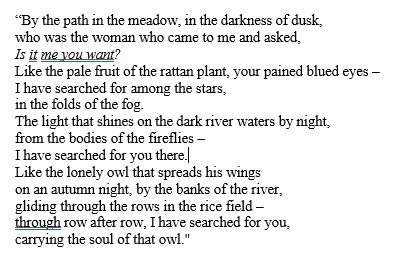
The lights of Manhattan glimmered on the East River–the wind pressing on him. Emilio stood silently with his gaze there, as the whispers of a woman’s voice threaded through the years.


Leave a Reply